






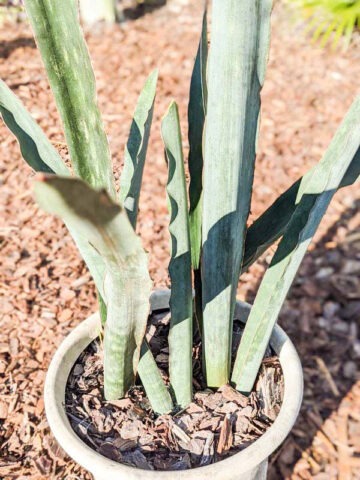
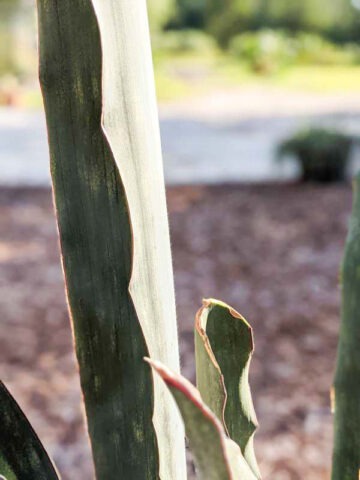

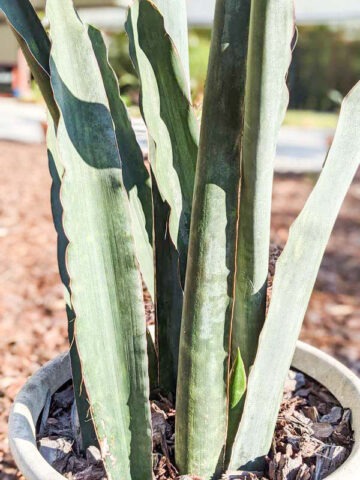
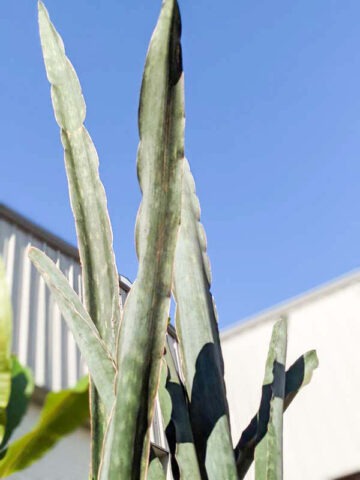
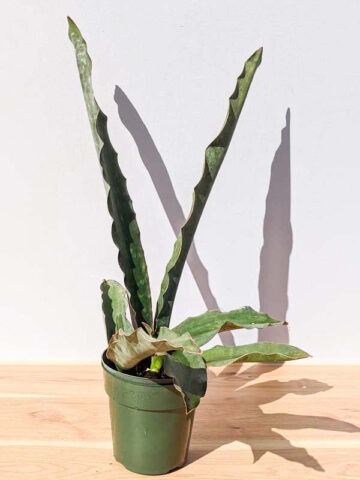
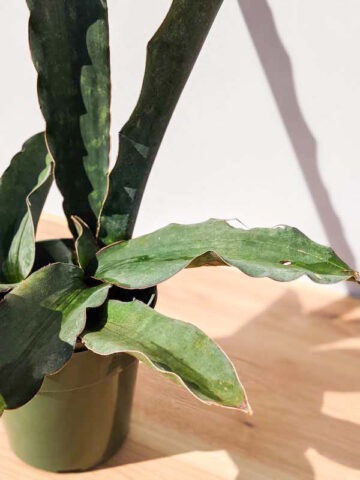
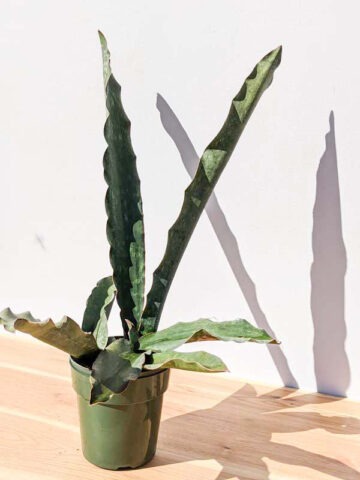

XL Gorgeous Kiboko African Super Clone, Largest Known Snake Plant (sansevieria)
$149.00
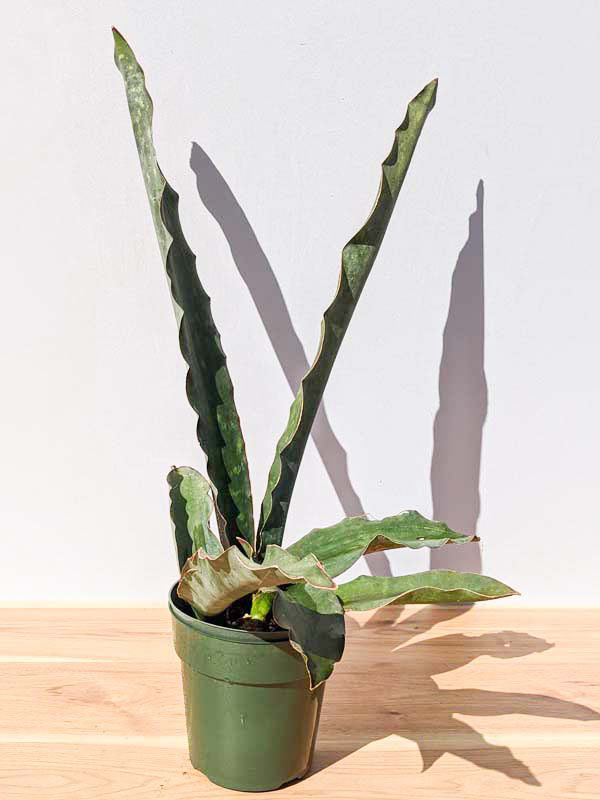
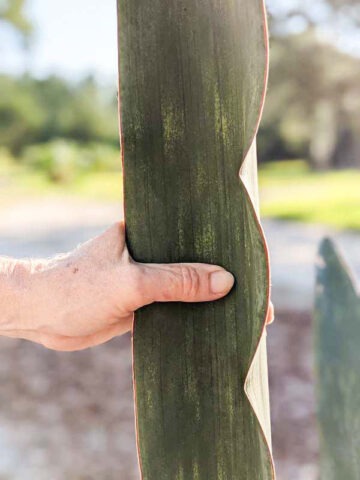
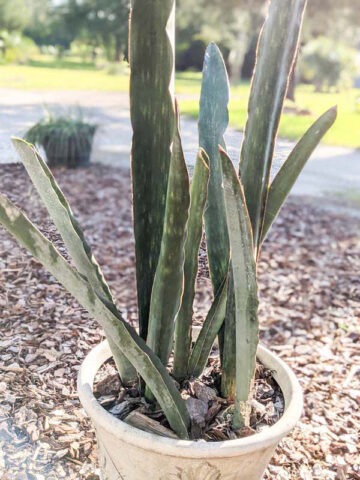
Kiboko African Super Clone is a bold, large-scale sansevieria selected for its exceptional size and presence. The thick, blue-green, sword-like leaves can reach up to four feet tall and grow an impressive one to two inches thick, giving the plant substantial weight and structure.
This variety is slow to establish, typically producing only 4 to 5 new leaves per year, but its eventual size and architectural impact make it a standout in interiors. The upright form and heavy foliage create a strong vertical accent suited to modern spaces and large containers.
From spring through early summer, lightly scented flowers may emerge at the base, adding seasonal interest. Commonly grown indoors, Kiboko is valued for its durability and tolerance of a range of light conditions. It also contributes to improved indoor air quality. Easy to maintain and forgiving, it performs well in homes, offices, and covered patio areas where bold form is desired with minimal upkeep.
Feel Confident: The Best Plants USA Born & Raised.
5 in stock
From a design standpoint, snake plants integrate well into multiple interior styles. In modern or minimalist spaces, their strong vertical lines complement clean architecture. In transitional or traditional rooms, they provide contrast against softer furnishings. Taller varieties are effective floor specimens in corners or beside furniture, while compact varieties function well on desks, shelves, countertops, and bedside tables. They are also commonly used in professional settings such as reception areas and conference rooms due to their low maintenance needs.
|
OUTDOOR
Zone 10a-11
|
PATIO
Zone 4a-11
|
|
SOIL TYPE
Rich Moist |
% SUN
70-90% |
|
PROPAGATE
Division / Leaf |
GROWTH
Moderate |
When repotting, gently loosen roots and inspect for any soft or damaged sections before placing in fresh soil. Repotting is generally needed every two to three years, or when rhizomes begin pressing firmly against the container walls. Proper planting depth, well-draining soil, and correctly sized containers are the key factors for long-term health and steady growth.
Water management indoors couldn't be easier. Because the leaves store moisture, the root system is sensitive to prolonged wet soil. Allow the potting mix to dry completely before watering again. In bright indoor light, watering is typically needed every 2–3 weeks. In lower light or cooler conditions, watering may only be required every 4–5 weeks. Always empty excess water from saucers or decorative outer containers. Overwatering remains the primary cause of indoor decline.
Temperature consistency indoors supports steady performance. Snake plants prefer 60–85°F and adapt well to normal household conditions. They should not be placed directly against cold windowpanes during winter or in areas exposed to strong drafts, heating vents, or air-conditioning airflow. Stable indoor environments promote even growth and reduce stress on the foliage.
Lighting flexibility is one of their strongest indoor advantages. They perform best in bright, indirect light, such as near east- or south-facing windows with filtered exposure. However, they remain stable in moderate to low light settings, including hallways, interior offices, and rooms with primarily artificial lighting. In lower light, growth slows and variegation may soften slightly, but the plant maintains its upright structure. Direct, intense afternoon sun through glass should be avoided, as it can cause leaf stress or bleaching.
Bedrooms: Snake plants adapt easily to bedroom environments with filtered light or softer indirect exposure. Position near a window with sheer curtains or along a wall opposite natural light. Compact varieties are suitable for nightstands or dressers, while taller types fit well in unused corners.
Home Offices: These plants tolerate artificial lighting and fluctuating indoor conditions, making them ideal for desks, shelving, or office corners. Place near a window if available, but they will maintain structure even under overhead lighting. Avoid direct placement under strong air vents.
Entryways & Hallways: Snake plants perform reliably in transitional spaces with limited natural light. Their upright form keeps walkways clear while adding greenery to narrow areas. Ensure occasional indirect light reaches the plant to maintain healthy coloration.
Sunrooms: In bright sunrooms, position snake plants where they receive filtered light rather than intense direct afternoon sun. Strong indirect light in these areas supports faster growth and fuller clumping over time.
Near Windows: East-facing windows are ideal. South- or west-facing windows are acceptable if light is filtered. Keep plants slightly back from glass during cold weather to avoid temperature stress.
Shipping Info.
All sales are now final as we are unable to accept returns/exchanges. All shipments over $100 are fully insured with the carrier and all orders over $700 will require a signature, Please track your order and have someone available.
SHIPPING & HANDLING RATES AND INFO.
At the current time we only ship to the lower 48 states. We do NOT ship to AK, HI, PR or internationally. Orders placed from these areas will be refunded and cancelled. Orders placed from the western regions in the US can have an extended delivery time up to 9 days, we strongly recommend selecting 2 day UPS or placing your order in early spring or late fall to avoid hot summer temps. In these regions you are accepting full responsibility for the shipment and understand the risks involved due to distance and temperatures. Western shipments are not guaranteed in the months of May-September.
**Please understand we are unable to constantly monitor the temperatures across the entire United States. If you know the temperatures in your area are not conducive to shipping plants enclosed in a box from Florida to your location, please wait until temperatures are more favorable. We do not guarantee plants due to extreme temperatures during shipping. All shipping rates include all shipping and handling fees.
**To better serve you, during certain times of the year, when heat and travel time may become an issue, we offer UPS 2 Day which may be considerably more expensive however safer for your shipment. Due to extended travel time and weather conditions we remove the UPS Ground options to some locations to prevent loss and heat damage.
An original unboxing video will be required for any claims(s) of shortage(s).
**About delivery time: During checkout you will notice the shipping time states "once shipped" in days but our "delivery time" is stated in weeks. That is because, our nursery typically receives over 1-2 hundred orders a week with orders consisting of 1 to 20+ plants each, which adds up to around 1,000 plants per week to prepare and ship, when we are only able to properly ship around 125 or so orders per week. We are a nursery of two people doing all the maintenance, propagation, shipping and customer service, working eight days per week. We do not take any short cuts while packaging and each plant is handled and treated with the utmost care. When the orders in our shipping queue reach 300, we turn off the site checkout process until the shipping queue is down to a manageable 200 or less orders.
Example:
1. You order on the first of the month with 2 day shipping.
2. Shipping queue orders are at 2-4 weeks.
3. At week 2-4 your order is ready to ship.
4. You selected two day shipping, so your order will be to you in 2 days after UPS picks it up.
All shipments are insured by UPS for transit loss.
WHAT ARE THE SHIPPING & HANDLING RATES? At the current time we do not ship to Alaska, Hawaii and Puerto Rico.
|
Local UPS Ground Shipping and Packaging to: Florida and Georgia. Orders Over $299.00 Ship Free! |
|
| Items Ordered | Shipping Charge |
| 1 | $15.00 |
| Plus | $4.50 per additional item. |
| Example | Shipping Total |
| 1 Item | $15.00 |
| 5 Items | $33.00 |
| 10 Items | $55.50 |
|
UPS Ground Shipping and Packaging to Eastern Regions: Alabama, Arkansas, Connecticut, DC, Delaware, Illinois, Indiana, Iowa, Kansas, Kentucky, Louisiana, Maine, Maryland, Massachusetts, Michigan, Minnesota, Mississippi, Missouri, Nebraska, New Hampshire, New Jersey, New York, North Carolina, Ohio, Oklahoma, Pennsylvania, Rhode Island, South Carolina, Tennessee, Texas, Vermont, Virginia, West Virginia and Wisconsin. |
|
| Items Ordered | Shipping Charge |
| 1 | $25.00 |
| Plus | $7.60 per additional item. |
| Example | Shipping Total |
| 1 Item | $25.00 |
| 5 Items | $55.40 |
| 10 Items | $93.40 |
|
UPS Ground Shipping and Packaging to Western Regions**: Arizona, California, Colorado, Idaho, Montana, Nevada, New Mexico, North Dakota, Oregon, South Dakota, Utah, Washington and Wyoming. When temperatures rise we only offer 2 day shipping o these destinations which is considerably higher than the rates shown. |
|
| Items Ordered | Shipping Charge |
| 1 | $35.00 |
| Plus | $8.99 per additional item. |
| Example | Shipping Total |
| 1 Item | $35.00 |
| 5 Items | $70.69 |
| 10 Items | $115.91 |
WHAT IF MY PACKAGE IS LOST OR STOLEN?
PLEASE TRACK YOUR PACKAGE! Once shipped all sales are final, tracking info. is automatically emailed as soon as it becomes available you must trace the shipment to your door, we simply ship the product to the address supplied to us on your invoice, we ARE NOT responsible for lost, stolen or damaged packages once delivered, this includes heat or cold damage when delivered outside. If you have any issues contact UPS, not us. Chances are you will loose all the money spent, so PLEASE TRACK YOUR PACKAGE and have someone there to accept it. Note: shipping delays may occur if we experience a heavier volume of orders.
Orders placed from the western regions can have an extended delivery time up to 8 days, we strongly recommend orders be placed in early spring or late fall to avoid hot summer temps. In these regions you are accepting full responsibility for the shipment, the mortality of the plants ordered and understand the risks involved due to distance and temperatures. Western shipments are not guaranteed in the months of June-September.
HOW ARE PLANTS PACKAGED FOR SHIPMENT?
Wow, like a present! With our state of the art packaging we can ensure that your new plant arrives in style. Before leaving our growers all plants are inspected, watered and pruned if necessary. Your new plant is bagged to keep the soil moist and to ensure that the soil stays in the pot not loose in the box. Then your plants are tissue or kraft paper wrapped and secured in place with natural biodegradable peanuts, you will be pleased.
DO YOU SHIP PLANTS ANY TIME OF THE YEAR?
Sorry, no we don't. Most of the plants offered are very tropical and require temperatures above 40º at all times. On occasion some orders may be delayed if the weather conditions in your area warrant that the shipment be held. This helps to ensure the survival of your new plant. During the winter months when we are no longer shipping plants, our growers spend their time researching new species and new growing techniques to provide you with the most unique and superior species of plants available anywhere.
HOW LARGE ARE THE POTS THE PLANTS COME IN?
It varies. All plants for sale will vary in size. In the spring, plants are often smaller than plants shipped in the fall. Most plants designated with a sku ending in -4, -6 or -8 will arrive in a standard 4 inch, 6 inch or 8 inch round growers pot respectively, -2 will be in our new 11 cu. inch pot for stronger roots. Our new, reusable, recyclable deep pots are 8 inches deep and 3x3 inches in diameter. Products growing in these pots are easy to transplant and allow for deeper, faster growth and are designated with a -t3, most of these are often come with a 36" totem. (Note: The item sku number can be found just below the buy button.) The color and style of these pots may vary. If we are out of a particular size item, we may ship a larger size at no additional charge. You can see the various pot sizes and actual plants ready to ship.
ARE SHIPPING OPTIONS AVAILABLE?
No. Sorry, At the present the only shipping option available is UPS Ground ®. UPS ® has proven themselves in the industry and have become the carrier of choice for our family of growers. With reasonable rates, careful handling and on time service you can be sure that your shipment will arrive ready to be enjoyed.
HOW CAN I ESTIMATE THE ARRIVAL DATE?
To ensure proper delivery most orders will take 1 - 3 weeks. The delivery time can vary depending on the work load, seasonal holidays and your location. You will automatically be notified by email with tracking information when your order ships, allowing you to trace the shipment to its destination. Rest easy knowing that your plant will not ship until it is inspected, watered, bagged and properly packaged.
WILL ALL OF MY PACKAGES BE SHIPPED BY UPS?
Yes. We not only trust UPS® with our plants. They are the exclusive shipper of our growers when it comes to plants, pots and accessories.
CAN ORDERS BE SHIPPED OUTSIDE THE US?
Presently we only ship inside the lower 48 states. With the current USDA regulations regarding shipment of live plants, our family of growers are restricted to and governed by the guidelines for certification within the lower 48 states only. Orders shipping to Alaska, Hawaii and internationally will not be accepted.
CAN I CHANGE A SHIPPING ADDRESS ONCE I'VE PLACED AN ORDER?
We're sorry. Shipping information can only be changed if you email our customer service immediately after your order has been submitted. We process orders very quickly, and once an order begins the fulfillment process we're unable to modify it. We apologize for any inconvenience, and we hope that in the majority of cases our faster processing times work to your advantage. If you have questions about your order, please contact us via email. click here
WILL MY PLANT SURVIVE IF IT ARRIVES WITH BROWN OR DAMAGED LEAVES?
Your, plant should be fine. Occasionally transit damage will occur. If your plant arrives a bit shaken and stressed, simply follow your plants "Care & Culture" instructions and it should return to its full beauty and luster with in a few weeks. Note: We do not warrant bent or broken leaves, it is only natural that some minor damage will occur. Certain plant varieties do not like to be shipped and can loose some or all of their leaves during transit, this is common and the plant is not dead, it is simply in shock and should bud within 30 days or so.
WHAT DO I DO IF MY SHIPMENT ARRIVES CRUSHED OR DAMAGED?
It depends on the extent of the damage. If your shipment arrives and the box is severely crushed or damaged, you can either refuse the shipment or place a "Claim" directly with UPS Ground for loss or damage at UPS.com. However, in doing this you must realize that if you have ordered an item that is in short supply or high demand, we can not guarantee a replacement.
WHAT DO I DO IF I DO NOT RECEIVE MY ENTIRE ORDER?
Read your packing slip. First, read your packing slip to be sure that everything you ordered has been shipped. Second, If you only receive a partial shipment don't worry. There is no need to panic. If your entire shipment does not arrive within 4 weeks from the time you placed your order, please e-mail us with your order number and name so we can trace the missing item(s) and promptly correct the situation. click here
CAN I CANCEL MY ORDER?
Sure, but you must do it quickly. Orders canceled after the UPS tracking information has been sent but prior to shipping will be charged a 30% restocking fee. Understand at that point your plants have been pulled from various greenhouses, tagged, cleaned, bagged, watered, wrapped, bagged again, packaged with p-nuts, paperwork, box, tape and state permits. If for any reason you need to cancel an order it must be done ASAP prior to packaging for a full refund. Due to the current global environment, ALL SALES ARE FINAL ONCE ITEMS ARE IN THE POSSESSION OF THE CARRIER. No refunds or compensation will be provided for any reason.
WHAT IS YOUR PHONE NUMBER?
Sorry, There is no available telephone number. Our team members are always in the field maintaining the foliage. Email is the most efficient way to answer questions and concerns. click here
MY ORDER JUST ARRIVED, WHAT DO I NEED TO DO TO THE PLANTS?
Immediately unpack your plants very carefully, most damage occurs in the hurried attempt to see the new plants. When your plants arrive you will need to water them if necessary.
WHAT PLANTS ARE SAFE FOR KIDS AND PETS?
You will have to do your research. We make absolutely no claims as to plant safety, of any plant whatsoever. If in question, please do your homework prior to ordering. For your pets you may want to visit the ASPCA. Please read our Terms of Service and Return Policies prior to purchasing.
